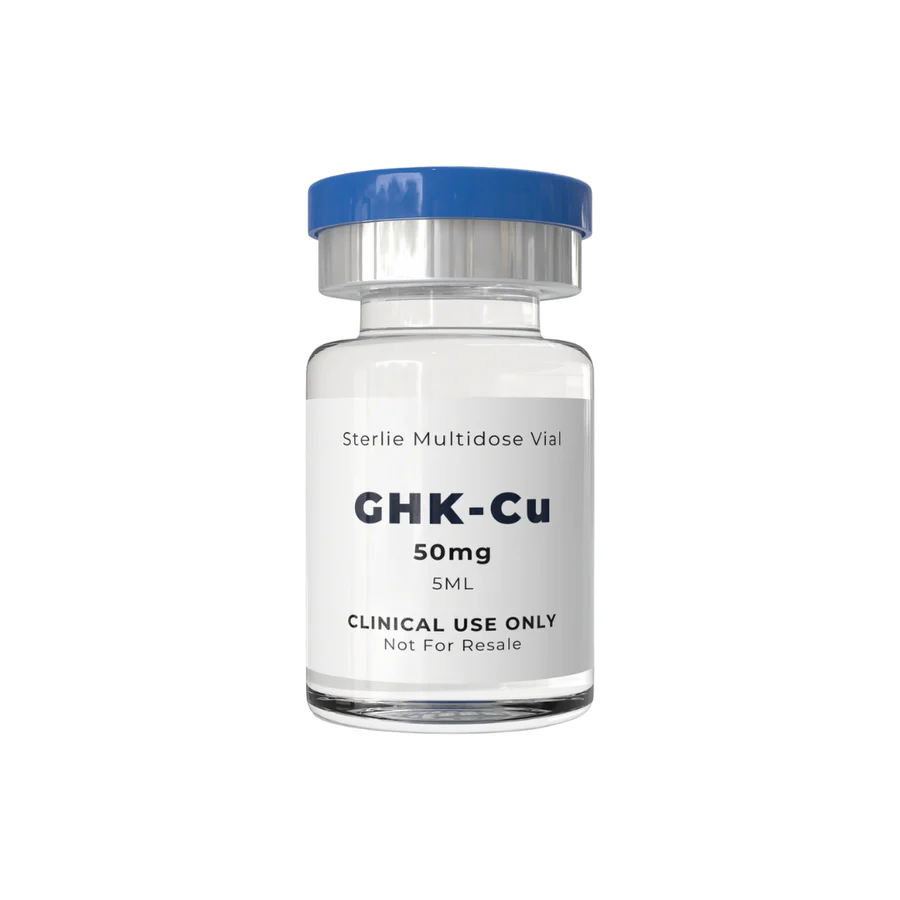
What is GHK-Cu?
GHK Cu (glycyl-L-histidyl-L-lysine complexed with copper(II )) is a naturally occurring peptide detectable in human plasma, saliva, and urine. It was discovered in 1973 by Dr. Loren Pickart and is often referred to as the „youth peptide“ due to its significantly decreasing blood concentration with age—from approximately 200 ng/ml in a 20-year-old to below 80 ng/ml in a 60-year-old.
Chemically, GHK is a small tripeptide (a chain of the three amino acids glycine, histidine, and lysine) with a high affinity for copper(II) ions. It functions as a natural transport system, delivering copper into cells. Copper is an essential trace element required for important enzymatic reactions, including those involved in collagen synthesis, antioxidant defense, and angiogenesis (blood vessel formation). By binding copper to the GHK peptide, the metal is stabilized, becomes less cytotoxic, and can be efficiently transported to target tissues.
GHK-Cu is considered a multifunctional signaling peptide. Studies using the Broad Institute’s Connectivity Map have shown that GHK can alter the expression of approximately 31.2% of human genes by more than 50%, thereby shifting cellular activity from a disease-related or aged state to a healthier, regenerative state.
Mechanism of action: How GHK-Cu works
Unlike harsh peels or simple moisturizers, GHK-Cu is a bioactive regulator that interacts directly with cellular DNA. Its main mechanisms include:
Extracellular matrix (ECM) remodeling: GHK-Cu is a potent stimulator of collagen (types I and IV) and decorin synthesis. It inhibits matrix metalloproteinases (MMPs) and promotes the production of glycosaminoglycans (GAGs) and proteoglycans, which are essential for skin structure and hydration.
Antioxidant and anti-inflammatory effects: GHK-Cu increases the expression of antioxidant genes while simultaneously reducing inflammation. It blocks the formation of reactive oxygen species (ROS), detoxifies lipid peroxidation products such as acrolein, and protects cells from UVB damage.
Stem cell modulation: The peptide has been shown to increase stem cell properties (the ability of stem cells to maintain their undifferentiated state and renew themselves) and the secretion of trophic factors from mesenchymal stem cells, thus supporting systemic regeneration.
Copper homeostasis: It regulates copper transport and uptake, thus preventing the accumulation of free copper, which can be toxic and pro-inflammatory.
Clinical applications and benefits
A. Skin Rejuvenation & Anti-Aging
This is the best-documented application of GHK-Cu.
Collagen production: Several studies have shown that GHK-Cu stimulates collagen production more effectively than vitamin C and retinoic acid. In one study, GHK-Cu increased collagen deposition in 70% of participants, compared to 50% with vitamin C and 40% with retinoic acid.
Photoaging: A 12-week study with 71 women with photoaging skin showed that a GHK-Cu cream significantly improved skin elasticity, clarity and firmness and reduced fine lines and wrinkles without irritation.
Synergy with hyaluronic acid: In combination with low molecular weight hyaluronic acid (HA), GHK-Cu showed a synergistic effect and increased collagen IV production in cell models by up to 25 times.
B. Wound Healing & Tissue Repair:
GHK-Cu accelerates the body’s natural repair processes. It promotes angiogenesis, nerve growth, and the formation of granulation tissue. A Phase II clinical trial (CuHeal) (as of February 2026) is currently underway to evaluate a topical 0.1% GHK-Cu gel for the treatment of acute wounds in healthy adults. The trial measures the time to complete re-epithelialization of standardized punch biopsy wounds.
C. Hair growth
Research distinguishes between GHK-Cu and a variant, AHK-Cu.
AHK-Cu is particularly distinguished by its strong hair-regenerating effect. It has been proven to stimulate the longitudinal growth of human hair follicles, increase the proliferation of dermal papilla cells (DPCs), and significantly reduce apoptosis (cell death) in hair follicles.
GHK-Cu improves collagen and scalp structure, supports hair follicle health, and strengthens the hair shaft. In some preclinical models, results comparable to those achieved with minoxidil were observed.
D. Current Research: Cognitive Health
A fascinating preprint study (April 2026) on aged mice investigated different routes of administration of GHK-Cu.
Intranasal (IN) application: A significant improvement in cognitive abilities was observed in spatial orientation tasks. Oxidative phosphorylation and MYC target pathways were inhibited, suggesting a reduction in markers of metabolic aging.
Intraperitoneal (IP) application: Acute stress responses and DNA repair pathways were triggered.
Conclusion: The application method influences the molecular effect, but the improvement in cognitive abilities was achieved regardless. This suggests a potential neuroprotective effect of GHK-Cu.
Instructions for use and dosage
GHK-Cu is mainly applied in two ways: topically (for local effects on skin and hair) and injectably/systemically (for systemic healing).
Topical application (creams, serums and microneedling)
This is the safest and easiest method to use.
Concentration recommendations:
Face (general): 1–2%
Eye area: 0.5–1% (thinner skin is more sensitive)
Scalp: 2–3% (thicker skin tolerates higher doses)
Frequency of use: Once daily (usually in the evening).
Microneedling: Using a 0.5 mm dermaroller before the procedure can significantly increase absorption (up to 100 times). However, a burning sensation is to be expected.
Injectable GHK-Cu (subcutaneous)
Disclaimer: The following information is for educational purposes only. This use is considered off-label/experimental and carries risks. Consult a physician.
Dosage: The typical research cycle is 1.5 mg to 2 mg per day.
Cycles: The standard protocol specifies 30 days of application followed by 30 days of rest to avoid copper overload.
Reconstitution (example for a 100 mg vial):
Mix with 3 ml of bacteriostatic water.
Concentration = 33.3 mg/ml.
To draw up 2 mg, use approximately 6 units of a U-100 insulin syringe.
Safety, contraindications and the “zinc rule”
The “copper side effects” (topical)
Excessive topical application can lead to so-called „copper side effects“—a term for inflammation, sagging, or dermatitis caused by excessive enzyme activation. More is not better.
Interactions with other ingredients (topical)
GHK-Cu must not be mixed with:
High-dose vitamin C (L-ascorbic acid): The low pH of vitamin C destabilizes the copper peptide, rendering both ineffective or causing skin irritation.
AHAs/BHAs (acids): These cleave the peptide bonds.
High-dose retinoids (same application): Overwhelm the skin barrier. Solution: Use a „skin cycle“ – vitamin C in the morning, alternating copper peptides and retinoids in the evening.
⚠️ The Zinc Rule (Systemic Application)
Copper and zinc compete for absorption in the body. GHK-Cu injections increase copper levels, which can unintentionally lead to zinc deficiency.
Instructions for use: Zinc must be supplemented daily during a GHK-Cu injection cycle.
Dosage: 15–30 mg zinc picolinate or glycinate daily.
Warning: Do not exceed a dose of 50 mg long-term without medical supervision.
Deficiency symptoms: Metallic taste in the mouth, difficulty concentrating, or increased hair loss.
| Menge | 5xGHK Cu, 10xGHK Cu, 20xGHK Cu, 50xGHK Cu |
|---|
Ähnliche Produkte
Kaufen Sie Peptide
Kaufen Sie Peptide
Kaufen Sie Peptide

Kaufen Sie Peptide

Kaufen Sie Peptide

Kaufen Sie Peptide
Kaufen Sie Peptide
Kaufen Sie Peptide