
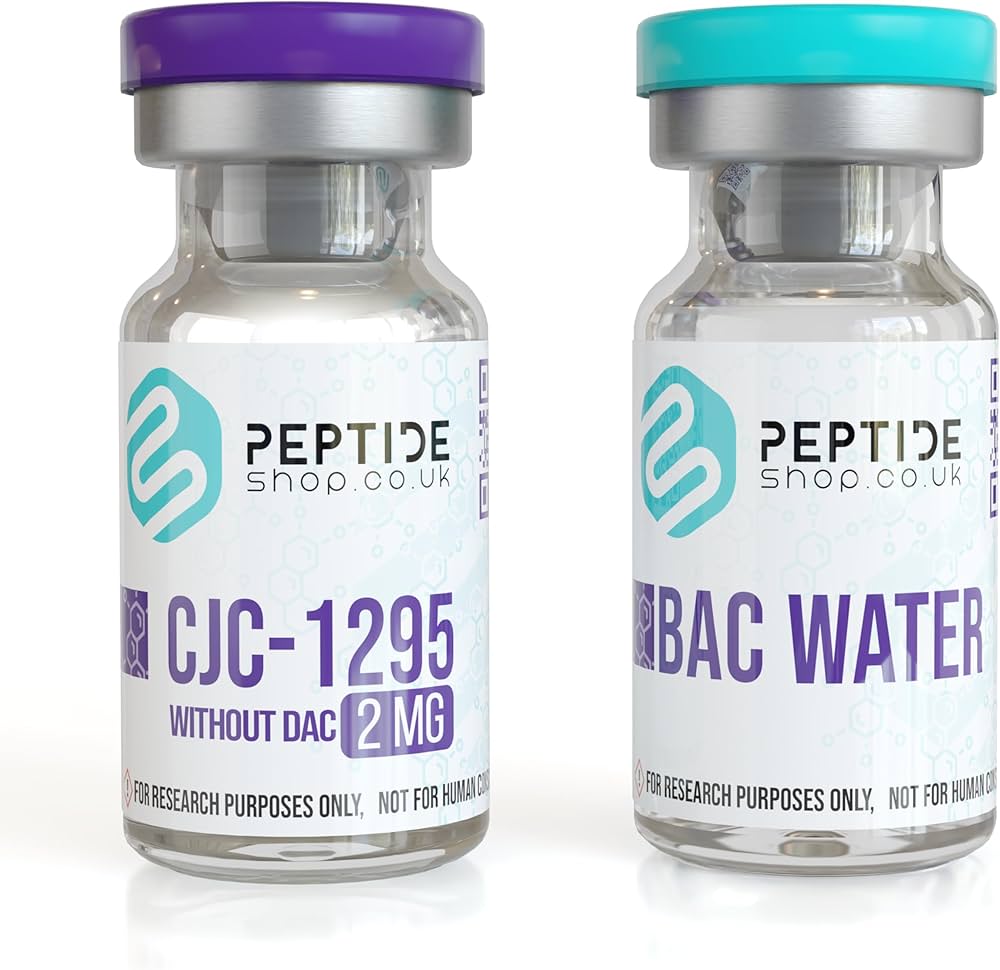
What is CJC 1295 and how does it work?
CJC 1295 is a synthetic analogue of growth hormone-releasing hormone (GHRH). To understand its function, one must first consider the growth hormone axis. This axis involves the release of GHRH by the hypothalamus, which signals the pituitary gland to produce growth hormone (GH). This GH travels to the liver, where it releases insulin-like growth factor 1 (IGF-1), the primary driver of anabolic processes such as muscle protein synthesis and tissue repair.
CJC-1295 is a synthetic peptide, more precisely a chain of 30 amino acids, that mimics natural GHRH. Its primary function is to bind to the GHRH receptors of the pituitary gland. This causes a sustained increase in the production and release of endogenous growth hormone, leading to elevated IGF-1 levels, without completely disrupting the body’s natural feedback mechanisms.
The crucial difference: CJC-1295 with DAC vs. without DAC
When researching this active ingredient, you will come across two different versions. The difference lies in a modification, the so-called Drug Affinity Complex (DAC), which fundamentally alters the peptide’s behavior in the body.
CJC-1295 with DAC (long-lasting effect)
This variant is covalently bound to DAC and can thus bind to albumin in the blood. This protects the peptide from rapid degradation. As a result, it has a half-life of approximately 8 days. Instead of mimicking a natural pulse, it causes a sustained release of growth hormone (GH) and IGF-1, keeping levels elevated for up to two weeks after a single injection.
CJC-1295 without DAC (Mod. GRF 1-29)
This variant, often referred to as Modified GRF 1-29, does not contain a DAC component. Although it is still modified to resist enzymatic degradation, its half-life is only about 30 minutes. This variant is preferred by users who wish to mimic the body’s natural, pulsatile release of growth hormone (GH), which typically requires daily injections.
Alleged benefits and research applications CJC 1295
Although clinical studies in humans regarding athletic performance are limited, the physiological effects of increased GH and IGF-1 levels provide a solid theoretical basis for various benefits.
Muscle Regeneration and Body Composition:
The primary interest in CJC-1295 for muscle regeneration stems from the role of IGF-1. As a mediator of growth hormone (GH), IGF-1 promotes satellite cell proliferation and muscle protein synthesis. By maintaining a sustained anabolic environment, the peptide is believed to accelerate the repair of exercise-induced muscle damage and support the development of lean body mass.
Metabolism and fat loss
research suggests that stimulating the GH axis can influence fat burning in the body. CJC-1295 has been investigated for its potential to reduce visceral fat. GH promotes lipolysis (the breakdown of fats), suggesting that the use of peptides could support fat loss while preserving lean body mass.
Sleep and Recovery:
Natural GH release occurs predominantly during deep sleep (slow-wave sleep, SWS). There is an interaction here: GHRH analogs can potentially prolong the duration of deep sleep, leading to more restorative sleep and thus better physical regeneration.
Study results and dosage protocols
Human studies confirm that CJC-1295 is a potent secretagogue. A landmark study by Teichman et al. (2006) showed that a single dose of CJC-1295 in combination with DAC increased GH levels in healthy adults for up to 6 days and IGF-1 levels for up to 14 days.
CJC 1295 dosage was varied in studies:
Long-term effect (with DAC): In studies, doses of 2 mg were administered once or twice weekly. Due to the long half-life, treatment protocols often recommend a „hormone break“ (e.g., 3 months of treatment, 3 months break) to prevent desensitization of the pituitary gland.
Short-term effective (without DAC): Typical protocols involve daily subcutaneous injections of 100 µg to 300 µg, often at bedtime to take into account the body’s natural release rhythm.
Safety, side CJC 1295 effects and regulatory status
CJC-1295 is not FDA-approved for general use and is classified as an experimental research chemical. However, clinical studies have described specific side effects of CJC-1295.
Common side effects
Reactions at the injection site: redness, swelling or pain at the injection site.
Flushing and headache: Due to vasodilation (widening of the blood vessels).
Water retention: Edema in the hands and feet, which can lead to a tingling sensation (paresthesia) similar to carpal tunnel syndrome.
Long-term risks:
The most serious concerns relate to chronically elevated IGF-1 levels. Since IGF-1 is a mitogen (it promotes cell division), there is a theoretical risk that long-term use could accelerate the growth of existing cancer cells. Furthermore, growth hormone (GH) can cause insulin resistance and potentially increase blood sugar levels over time.
Regulatory Status:
It is important to note that CJC-1295 is strictly regulated. In many countries, including those that adhere to the WADA (World Anti-Doping Agency) Codes, CJC-1295 has been listed as a prohibited substance (S2. Peptide Hormones, Growth Factors) since 2019. Its sale for human use is restricted to research purposes.
Conclusion
CJC-1295 represents a promising approach to modulating the growth hormone axis using synthetic GHRH analogs. While data confirm its efficacy in increasing GH and IGF-1 levels, the functional benefits for muscle recovery and fat loss are currently based more on mechanistic theories than on long-term studies.
| Menge | 5xCJC-1295 with DAC 2mg, 5xCJC-1295 without DAC 2mg |
|---|
Ähnliche Produkte
Kaufen Sie Peptide

Kaufen Sie Peptide
Kaufen Sie Peptide
Kaufen Sie Peptide

Kaufen Sie Peptide
Kaufen Sie Peptide
Kaufen Sie Peptide
Kaufen Sie Peptide